

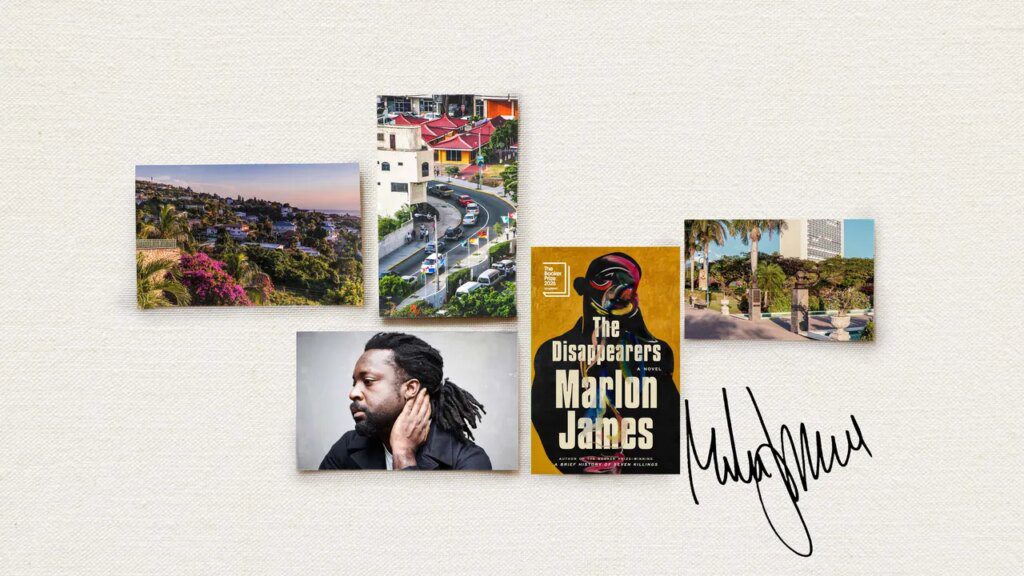
This is Write Here, a column where authors and literary luminaries tell us about the travels they took to find inspiration and create their latest books.
In this installment, Booker Prize-winning author Marlon James describes returning to his hometown of Kingston to write his new novel The Disappearers. In it, a group of queer men gathered to rehearse a play experience an anti-gay hate crime, and the story follows the survivors as they navigate the 1980s and ’90s in Jamaica. The riotous 640-page door stopper grapples with homophobia then and now, the lingering specter of colonialism, the tumult of the AIDS crisis, and frameworks of power that demand dominance or submission. To develop the Booker Prize-nominated book, James conducted research in Jamaica to better understand a queer history and heritage he had refused before coming out. Below, he describes how his travels across the Caribbean nation shaped his most personal work to date.
“I went to Kingston in 2023 and 2024 to do research for The Disappearers. For my books, I like to interview dozens of people, especially when I’m writing about something I don’t know a lot about. I grew up in Jamaica in the 1980s, but I didn’t experience queer life there—I was in the church, praying away the gay. So I looked into those years, but also from the early 2000s all the way back to the 1940s. I get curious about my characters’ lives before the novel even begins. Most of what I uncover in research never makes it directly into the book, but I just need to know for myself. To meet Jamaicans who could share their experiences in those eras, I spoke to local queer friends, and word just got around that I was looking. Because it’s a novel and not a documentary, a lot of people wanted to talk to me. They were very forthcoming about their lives. I even spoke to Jamaicans in New Orleans, Toronto, and Montreal who helped fill in the blanks, recalling what I never knew about Jamaica.
For example, given the country’s reputation as homophobic, I was shocked that, at one point, there were five gay bars in Kingston at the same time. They had wonderful names like Fanny Hill. There was Marshall’s—and then another Marshall’s because the co-owners had a falling out and they both refused to give up the name. There was The Closet, but then the people there also had a falling out, so some of them went to form their own club The Interim Closet. And there was Andante. Andante was a jazz bar, but everybody knew that by 9 p.m. the drag queens would perform. Celebrities and the brother of the prime minister would go to see the shows. But by the late ’80s and ’90s they were all gone. With the AIDS crisis, homophobia really exploded in Jamaica. As a religious country, we believe what preachers tell us, and they said AIDS was God’s punishment. The gay nightlife went underground, there were still parties, but the bars and clubs never lasted very long.
Talking to the older gays, I learned they’re just trying to get back to where Jamaica already was in 1972. I wanted to interview this guy who I think is 90, which would make him the oldest gay in Jamaica right now. He owns this artists’ retreat called Mountambrin, about an hour from Montego Bay. He started it as a hotel primarily for queer people, but he opened it up because he needed more guests and money. It’s still around and it’s for everyone, but you walk in and he has a lot of phallic art and statues of naked men, as one does. Gays are actually staying in Jamaica, which tells me there’s now a sort of hopefulness. In the past so many queer and trans people had to leave just to survive.